📝 2147 words | ⏱️ 12 min read | 🗓️ June 7, 2026 | 👤 MaxSao
Sony at 80 – The Extraordinary Rise From Post-War Ruins to Global Tech Icon (1946-2026)
💥How two visionaries rebuilt Japan’s future and created one of the most influential technology companies in the world
On May 7, 1946, exactly 80 years ago, engineer Masaru Ibuka (38) and physicist Akio Morita (25) founded a tiny startup in a devastated Tokyo still recovering from World War II. The company was called Tokyo Tsushin Kogyo K.K. – Tokyo Telecommunications Engineering Corporation – and it operated out of a bombed-out department store with barely 20 employees.
No one could have predicted that this fragile little workshop would evolve into Sony, one of the most powerful forces in global electronics, entertainment, music, cinema, and gaming.
From transistor radios to Walkman, from Trinitron to Blu‑ray, from the first compact disc to the legendary PlayStation, Sony shaped the modern world in ways few companies ever have.
2026 marks 80 years of innovation, reinvention, and cultural impact.

Subscribe for Gaming Updates & New Releases !!
Stay up to date with the latest game reviews, fresh releases, and curated recommendations delivered straight to your inbox.
No spam, just clean, structured gaming content.. Unsubscribe at any time.

[ How It All Began – Tokyo, 1946 ]
Japan in 1946 was a country in ruins. Cities destroyed, infrastructure collapsed, morale shattered.
But in the middle of this devastation, Masaru Ibuka set up a small radio repair shop inside the burned-out Nihonbashi department store.
Shortly after, Akio Morita – a brilliant young physicist – joined him.
Together, they shared a dream:
to rebuild Japan through technology, creativity, and engineering excellence.
Their first goals were modest:
- repair radios
- build simple electronic devices
- experiment with new technologies
But their ambition was anything but small.
Ibuka and Morita believed Japan could become a global leader in electronics – at a time when the world saw Japan only as a defeated nation.
[ Why “Sony”? The Birth of a Global Identity ]
In 1958, Tokyo Tsushin Kogyo changed its name to Sony, a combination of:
- sonus (Latin for “sound”)
- sonny boy (slang for a young, energetic innovator)
The name was short, international, and easy to pronounce – perfect for a company that wanted to conquer the world.
It was one of the first Japanese companies to adopt a Romanized global brand, decades before it became common practice.
[ The First Breakthroughs – Innovation After Innovation ]
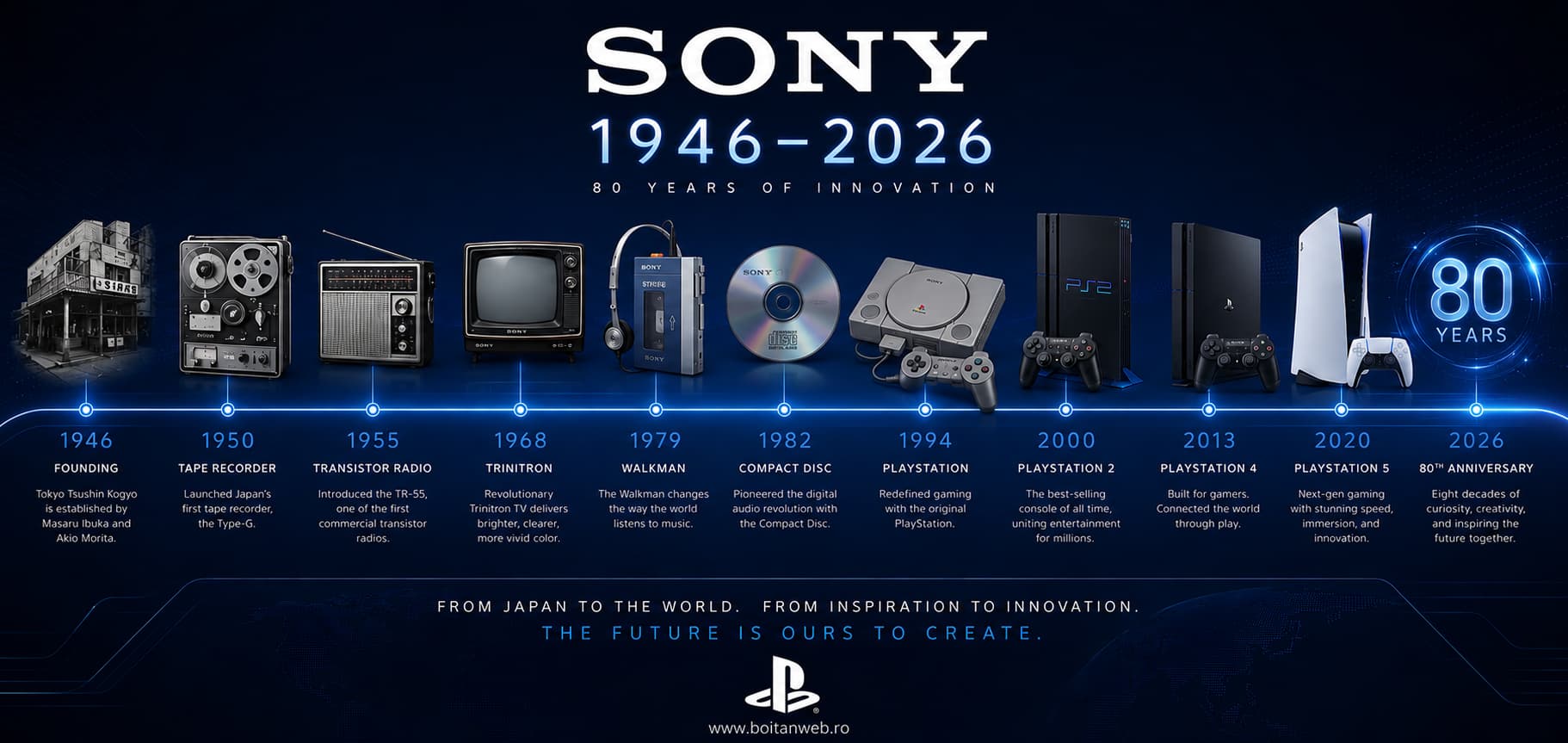
1950 – Japan’s First Tape Recorder (Type-G)
A symbol of post-war recovery and Sony’s first major engineering achievement.
1955 – Japan’s First Transistor Radio (TR-55)
A revolution in portable audio.
Sony became the company that made music mobile.
1960s – Trinitron TVs
A technological masterpiece that dominated the global TV market for decades.
1979 – Walkman
The device that changed how the world listens to music.
A cultural phenomenon.
1982 – Compact Disc (CD)
Sony co-created the CD standard with Philips, shaping digital music forever.
1994 – PlayStation
The moment Sony stepped into gaming – and changed the industry permanently.
[ The PlayStation Era – A New Empire Begins ]
In the early 1990s, Sony entered the gaming world with a bold vision:
to create a console that treated games as cinematic experiences.
The original PlayStation (1994) became a global phenomenon, selling over 100 million units and launching franchises like:
- Final Fantasy
- Gran Turismo
- Metal Gear Solid
- Tekken
- Crash Bandicoot
Then came:
- PS2 (2000) – the best‑selling console of all time
- PS3 (2006) – the Blu-ray revolution
- PS4 (2013) – the social gaming era
- PS5 (2020) – ray tracing, SSD revolution, haptic immersion
PlayStation transformed Sony from an electronics giant into a cultural titan.
[ Sony Today – A Global Powerhouse ]
In 2026, Sony is a leader in:
- gaming (PlayStation)
- cinema (Sony Pictures)
- music (Sony Music)
- imaging (Alpha cameras)
- consumer electronics
- entertainment technology
- sensors and semiconductors
From a tiny workshop in a ruined Tokyo to a global empire – the journey is nothing short of extraordinary.
[ Why Sony’s 80th Anniversary Matters ]
Because Sony represents:
- Japan’s rebirth
- the power of innovation
- the courage to dream big
- the fusion of engineering and creativity
- the evolution of global entertainment
Few companies have shaped modern culture as deeply as Sony.
[ Conclusion – 80 Years of Vision, Courage, and Reinvention ]
From Ibuka’s small repair shop to Morita’s global vision, from transistor radios to PlayStation 5, Sony’s story is one of relentless innovation and fearless ambition.
For 80 years, Sony has pushed boundaries, broken rules, and redefined what technology can be.
And if history has taught us anything, it’s this:
Sony is far from finished.
The next revolution is already on the horizon.
→ To better understand how Sony and PlayStation shaped modern gaming identity, you can explore our in-depth article The Evolution of Gamer Culture, which traces how games transformed from arcade entertainment to a global cultural force.


→ Quick answers to common gaming questions.